By Colleen O’Donnell
December 13, 2021
Immigration and COVID concerns ranked high on the minds of voters in Germany, as in the U.S. Both countries saw some voting irregularities and a big jump in use of mail-in ballots this election, but had vastly different responses. Parallels and contrasts between the recent federal elections in Germany and the 2020 U.S. presidential election offer potential insights into international political trends, as well as possible solutions for lingering issues of deep partisan divisions in the U.S.
No matter which side of the political divide you’re on, the 2020 U.S. presidential election was one of the most problematic in our nation’s history. But how much does our two-party system contribute to the embattled nature of U.S. politics, and what could U.S. voters learn from a western multi-party democracy, such as Germany’s?
Germans had a federal election in September with far-reaching consequences – a new party will be in charge in their Parliament, which surprised some voters, and a new German Chancellor will lead the country, when Angela Merkel steps down in 2022 after 16 years as the leader of Germany.
Dr. Lisabeth Hock, Associate Professor of German at Wayne State University and Interim Director of the Junior Year in Munich program currently resides in Germany and was there during the recent election.
“quote”
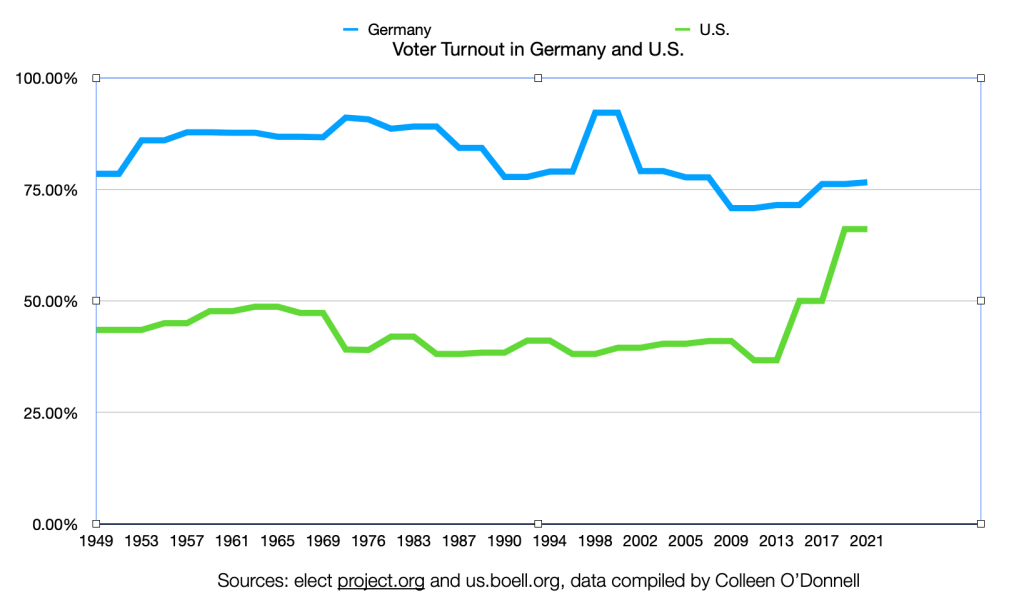
German voter turnout is high compared to the United States. The U.S. had record voter turnout in the 2020 election with 66 percent of eligible voters casting ballots, and yet voter turnout in Germany for their federal election this year was still about 10 percentage points higher than in the U.S. Over the past few decades, German voter turnout has been as high as 91% in 1972, and since 1949 has averaged around 80%, whereas during the same time period, U.S. voter turnout has hovered between 50-60% for most of the last century.
Here’s a look at how the voter turnout rates in U.S. and Germany stack up side by side:
Why do more Germans than Americans exercise their right to vote?
Dr. Hock and Dr. Daniel Schade, visiting assistant professor in the Department of Government at Cornell University, both weigh in on why voter turnout in Germany is consistently higher than in the U.S.:
How do Americans’ general tendencies stack up again Germans’? Hofstede Insights measures a series of traits in the culture of more than 60 countries internationally, based upon surveys of 60,000 people. The cultural insights they share are designed to assist international corporations with tailoring their products, services and marketing approaches to the prevailing culture of markets in other countries, but the trends Hofstede surfaces can also offer useful insights around political and voting behaviors.
The graphic below shows how the U.S. and Germany ranked in six traits on the Hofstede scale.
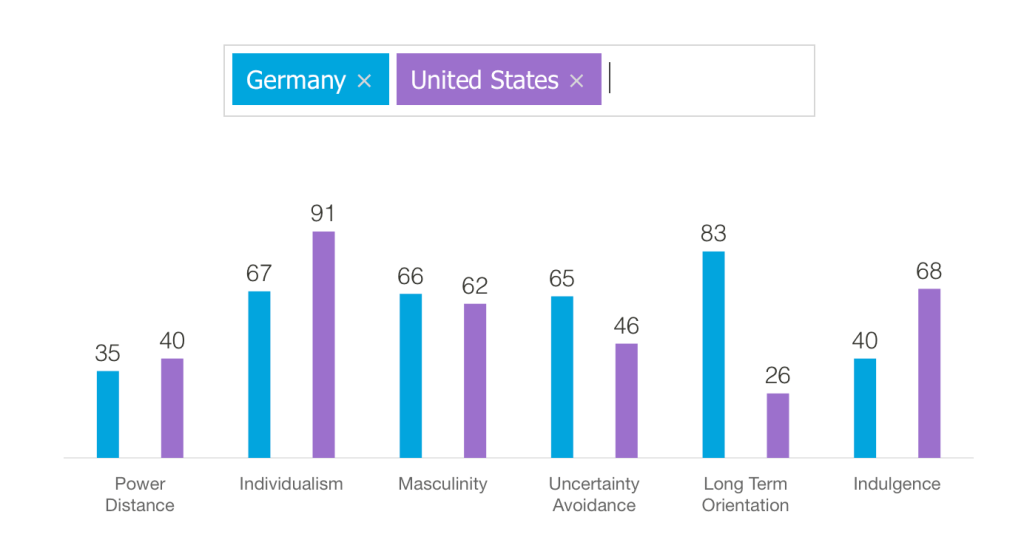
As indicated in the Hofstede country comparison (above), Germany and the US rank very similarly in the areas of Power Distance and tendency toward Masculinity, which according to Hofstede indicates that the two countries have similar views on the extent to which the less powerful members of institutions and organisations within a country expect and accept that power is distributed unequally in the area of Power Distance.
A high score on the dimension of Masculinity indicates that the society will be driven by competition, achievement and success, with success being defined by the winner / best in field – a value system that starts in school and continues throughout organizational life.
Also both countries are highly oriented toward Individualism, though the US scores 91, which is among the very highest in the world and more than 20 points higher than in Germany – indicating that the U.S. places an extraordinarily high value on the rights of the individual over the needs of society, and the importance of expressing individualism. Germany, on the other hand, based on the Hofstede ranking, is much more likely to recognize and prioritize collective needs of the country on more equal footing with individual rights.
Where the two countries differ most is in the area of long-term orientation. Germany scores very high (83) and the US very low (26). This could explain why Germany has been far ahead of the US in collective action regarding climate change, and before that in environmental consciousness, protections and sustainability.
The other factor with a significant gap is indulgence. Americans clearly have a much higher appetite for it (68) than Germans do (40). This elevated tendency in America can be seen in levels of indebtedness among Americans, as well as comparatively higher levels of opioid addiction, which Germany has all but completely avoided: https://www.addictioncenter.com/news/2020/02/opioid-addiction-germany-united-states/
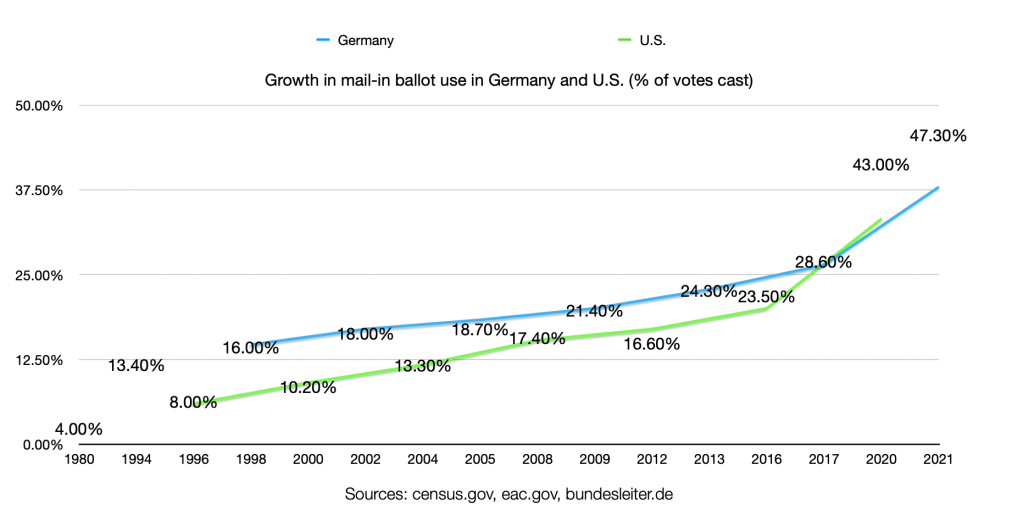
Germany is also working through a relatively peaceful transition of power, unlike the US. However a big difference is the record numbers of people voting by mail in Germany.
How has the pandemic affected voting in Germany, and what do Germans expect and hope for from the newly elected government?
(Video)
This map shows the locations and details of the German voters interviewed for this story:
 New Media Portfolio | Colleen O'Donnell