
December 23, 2021
By Colleen O’Donnell
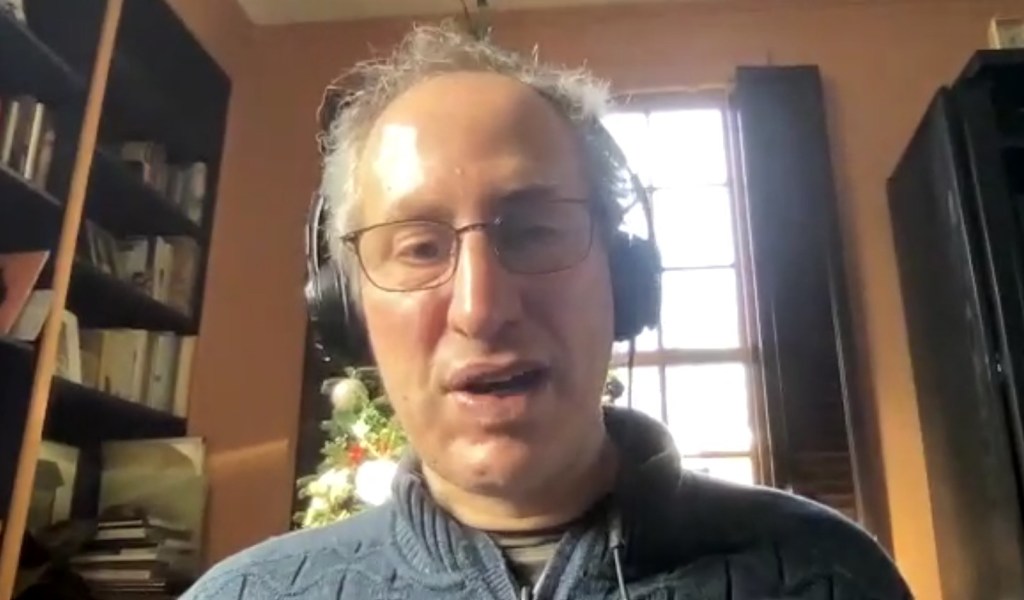
One year since the attempted insurrection at the U.S. Capitol, do we have clarity around the factors that led to it? As investigators unravel the role that fake news and disinformation played in the chain of events on January 6, 2021, and conversations play out in media, social media and among scholars – has anything changed in the year since this attack on our democracy? Where do we go from here? Harvard researcher Dr. Matthew Baum had some interesting answers – check out my interview with him in this podcast:
The damage done to democratic institutions and to productive civic dialogue resulting from fake news is well-documented.1 “The tectonic shifts of recent decades in the media ecosystem—most notably the rapid proliferation of online news and political opinion outlets, and especially social media—raise concerns anew about the vulnerability of democratic societies to fake news and other forms of misinformation.” (Baum, Lazer, Mele, 2017)
Disinformation not only breeds division among citizens and increasingly even within families, but also undermines the fabric of our democracy — with a chilling effect on productive discourse and subversion of a shared set of facts on which to base decisions that impact society as a whole.
“…the use of technology and social media as well as the emergence of new political narratives has been progressively changing the information landscape, undermining some of the pillars of democracy.” (Giusti and Piras)
With lines between reality and delusion seeming to blur ever farther on the daily in our nation’s politics and media, it is perhaps starkly ironic that the work of international scholars compiled in Democracy and Fake News: Information Manipulation and Post-Truth Politics, begins with editors Giusti and Piras quoting a fictional Russian character to illustrate the psychological impact of a culture of lies:
“‘What is the cost of lies? The real danger is that if we hear enough lies, then we no longer recognize the truth at all. What can we do then? What else is left but to abandon even the hope of truth and content ourselves instead with stories?'”
Valery Legasov, HBO Chernobyl
“The words of Valery Legasov, as pronounced in the HBO Chernobyl miniseries of 2019, perfectly reflect the disorientation produced by misinformation and by an intense flow of fake news that affects politics as well as everyone else’s everyday lives,” add Giusti and Piras.
Culturally and politically, the United States swirls at the epicenter of the current global fake news crisis — and snipes from U.S. politicians, their devotees, resisters, and attendant media outlets from both ends of the political spectrum dominate the Twitter-verse and a host of new alternative social media startups. The U.S. is no stranger to political tribalism, but what’s distinctly different in recent years is the erosion of an agreed-upon base level reality from which each side constructs its priorities and proposed solutions, which can then be debated, honed and tested.
The “marketplace of ideas” seems to have morphed into a marketplace of realities.
The “marketplace of ideas” seems to have morphed into a marketplace of realities, with hardened fronts and neither side willing to concede an inch, even in the face of irrefutable evidence. And with professional PR machines crafting messaging for those with the means to afford it, at what point does “framing” become “gaslighting”?
With so much opinion posing as news, primetime national media outlets choosing sides, and partisan sparring reaching levels where talk of “civil war” is openly discussed, the stage for the events of January 6th was set long before it happened.
Nevertheless, some Americans seem better able to successfully navigate the disinformation ecosystem, while alarming numbers of others fall prey to manipulation, become victims of grifting, and can even be incited to criminal activity and other actions not in their best interests.
Is it that vast swaths of the general public don’t know how to accurately vet information? Or what is behind this trend?
With the goal to better understand the factors that lead some people to be more susceptible to fake news – and what the best means are to combat the spread, to the extent that it’s possible – I spoke with Dr. Matthew Baum of Harvard University’s John F. Kennedy School of Government.
Dr. Baum is co-author of the report “Combating Fake News: An Agenda for Research and Action,” published in 2017 by the Harvard Kennedy School and Northeastern University.
The report put forth a set of short-term and long-term recommendations, which included steps such as “involving more conservatives in the discussion of misinformation in politics, collaborating more closely with journalists in order to make the truth “louder,” and developing multidisciplinary community-wide shared resources for conducting academic research on the presence and dissemination of misinformation on social media platforms.” (Baum, Lazer, Mele, 2017)
Their longer term recommendations suggested “we must investigate what the necessary ingredients are for information systems that encourage a culture of truth.” (Baum, Lazer, Mele, 2017)
However, with fake news showing no signs of slowing down since Baum’s report, but rather appearing to lead to even greater havoc against our democratic processes, our legal system, our public discourse and even public health during the ongoing COVID-19 pandemic, I reached out to Dr. Baum seeking answers to some of the bigger questions:
What is the psychology of fake news that makes it so irresistible to some people?
- Can anything be done to reduce a person’s susceptibility to fake news?
- Has there been progress in reducing the amount of fake news and its impact?
- What can ordinary people do to be well-informed and avoid falling prey to misinformation?
Here is my conversation with Dr. Baum, who had some surprising answers:
For more insights on the topic of fake news, view information from Harvard’s Shorenstein Center’s Misinformation Speaker Series.
View Dr. Matthew Baum’s latest research here.
You can also check out these podcasts with Ciaran Carr of the Mass Disinformation podcast:
Colleen O’Donnell Discusses Disinformation
Artificial Intelligence: Friend or Faker?
References:
1Democracy and Fake News: Information Manipulation and Post-Truth Politics, edited by Serena Giusti and Elisa Piras: Abingdon, Oxon ; New York, NY : Routledge, 2021. LCCN 2020031087
2“Combating Fake News: An Agenda for Research and Action,” Baum, Matthew, Lazer, David, Mele, Nicco; Harvard Kennedy School and Northeastern University, 2017.
Additional References:
Calvillo, Dustin P; Ross, Bryan J; Garcia, Ryan J. B; Smelter, Thomas J.; & Rutchick, Abraham M. (2020). Political Ideology Predicts Perceptions of the Threat of COVID-19 (and Susceptibility to Fake News About It). Social Psychological and Personality Science 2020, Vol. 11(8) 1119-1128. https://journals-sagepub-com.proxy.lib.wayne.edu/doi/pdf/10.1177/1948550620940539
Calvillo, Dustin P., Garcia , Ryan J.B., Bertrand, Kiana & Mayers, Tommi A. (2021). Personality factors and self-reported political news consumption predict susceptibility to political fake news. Personality and Individual Differences, Volume 174, May 2021, 110666. https://www-sciencedirect-com.proxy.lib.wayne.edu/science/article/pii/S0191886921000416?via%3Dihub
Duplaga, M.; Grysztar, M. The Association between Future Anxiety, Health Literacy and the Perception of the COVID-19 Pandemic: A Cross-Sectional Study. Healthcare2021,9,43. https://doi.org/10.3390/healthcare9010043
Gangireddy, S. C., Padmanabhan, D., Long, C., & Chakraborty, T. (2020). Unsupervised Fake News Detection: A Graph-based Approach. In 31st ACM Conference on Hypertext and Social Media: Proceedings (pp. 75-83). Association for Computing Machinery (ACM). https://doi.org/10.1145/3372923.3404783
Lee, Sian; Forrest, Joshua; Strait, Jessica; Seo, Haeseung; Lee, Dongwon; & Xiong, Aiping (2020). Beyond Cognitive Ability: Susceptibility to Fake News Is Also Explained by Associative Inference. CHI EA ’20: Extended Abstracts of the 2020 CHI Conference on Human Factors in Computing Systems, April 2020 Pages 1–8. https://doi.org/10.1145/3334480.3383077
Murphy, G., Murray, E., & Gough, D. (2021). Attitudes towards feminism predict susceptibility to feminism-related fake news. Applied Cognitive Psychology, 35(5), 1182–1192. https://doi.org/10.1002/acp.3851
Pennycook, Gordon; Rand, David G. (2019). Lazy, not biased: Susceptibility to partisan fake news is better explained by lack of reasoning than by motivated reasoning. Cognition, Volume 188, 2019, pages 39-50, ISSN 0010-0277.(https://www.sciencedirect.com/science/article/pii/S001002771830163X)
Shen, Tracy; Cowell, Robert; Gupta, Aditi; Le, Thai; Yadav, Amulya; & Lee, Dongwon (2019). How Gullible Are You?: Predicting Susceptibility to Fake News.WebSci ’19: Proceedings of the 10th ACM Conference on Web Science, June 2019, Pages 287–288. https://doi-org.proxy.lib.wayne.edu/10.1145/3292522.3326055
Shu, Kai; Wang, Suhang; Liu, Huan (2019). Beyond News Contents: The Role of Social Context for Fake News Detection. The Twelfth ACM Inter- national Conference on Web Search and Data Mining (WSDM ’19), February 11–15, 2019, Melbourne, VIC, Australia. ACM, New York, NY, USA, 9 pages. https://doi.org/10.1145/3289600.3290994
 New Media Portfolio | Colleen O'Donnell